
Responsible Gaming
Read practical information about gambling harm, financial boundaries, warning signs, account restrictions, blocking tools and finding appropriate support.
Money-game activity can affect finances, time, relationships and wellbeing. A bonus, winning result or advertised strategy does not make those risks disappear.
This page explains warning signs and practical ways to reduce exposure or stop. It does not encourage participation in a prohibited service or suggest that a set of personal limits makes gambling risk-free.
Sikkimgameapk.net is an informational publisher. We cannot close an external operator account, enforce a self-exclusion request or provide individual clinical care.
Legal Availability Comes First
India’s framework prohibits online money games. Being an adult, setting a budget or using an overseas website does not make a prohibited service permissible.
Readers elsewhere also need to consider the rules applying to the actual activity and location. A website being accessible is not proof of authorization.
Responsible-use information is protective guidance. It is not a substitute for legal availability or a reason to bypass restrictions.
Gambling Is Not a Financial Plan
Do not rely on gambling to pay rent, cover education costs, clear debts or replace regular income. A successful result does not make future income predictable.
Promotional credit can encourage further activity while carrying conditions that are easy to overlook. A large displayed bonus is not the same as money available for essential spending.
Be wary of people selling guaranteed predictions, recovery systems or paid access to “inside” results. An earnings screenshot does not establish that a method works or that the sender can recover a loss.
Warning Signs Worth Taking Seriously
Consider whether you are:
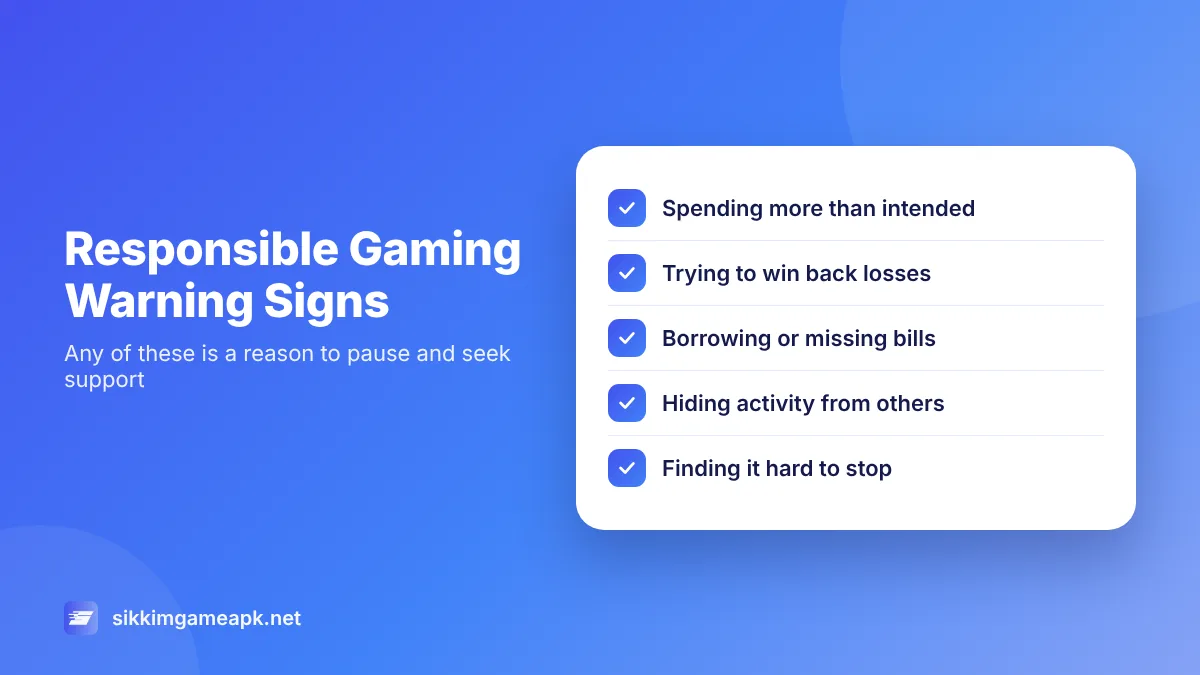
Spending more time or money than you intended.
Trying to win back previous losses.
Hiding activity or giving misleading explanations about spending.
Borrowing money or missing essential payments.
Thinking about gambling when you need to focus elsewhere.
Losing sleep or withdrawing from ordinary activities.
Finding it difficult to stop despite deciding to do so.
These signs are reasons to seek support, not a test you must pass before asking for help. You do not need to wait for a crisis or a particular amount of debt.
Stop Chasing Losses
After a loss, the urge to recover the money can change the reason for continuing. The focus may shift from entertainment to undoing what has already happened.
A larger stake does not provide a reliable route back to the starting balance. It increases the amount you can lose.
If you notice this pattern, step away from the account and avoid another payment. Speak with someone you trust or an appropriate support professional about the pressure to continue.
Protect Essential Money
Keep money needed for housing, food, bills, education, medical care and existing obligations separate from any discretionary spending.
Do not borrow, use credit or sell essential belongings to continue gambling. If money has already been lost, another bet is not a dependable debt-management plan.
Review the actual bank records rather than relying only on a game balance or selected wins. Where gambling-related debt is affecting essentials, seek independent financial or debt support available in your location.
Reducing Access and Prompts
Practical barriers can create distance between an urge and an action. Depending on the tools available, these may include removing saved payment details, stopping promotional messages and turning off gambling-related notifications.
A bank may offer controls for certain gambling payments. Ask what its controls cover rather than assuming that every transaction type will be blocked.
Website-blocking software or device restrictions may also help. Check their scope, supported devices and limitations, and consider support alongside technical controls.
Removing an app alone may not close the account or stop promotional messages. Check those issues separately.
Time-Outs, Account Closure and Self-Exclusion
A time-out, account closure and self-exclusion can have different meanings under a service’s rules. Ask the operator to explain the option, duration and effect in writing.
Self-exclusion generally involves asking a covered business or scheme to prevent gambling access for a period. Coverage depends on the operator, scheme and jurisdiction; it is not automatically worldwide.
Use the identified operator’s verified channel. Save the request and acknowledgement, and state whether marketing contact should also stop.
Do not create a new account to get around an exclusion. If an excluded account remains accessible, record the issue and seek help through the relevant support or complaint route.
Existing Funds and Records
Before closing an account, preserve records you can lawfully access, including the account identifier and any unresolved payment references.
Ask the operator how an existing balance or dispute will be handled without requiring further gambling. Do not delay protective action solely because a promotion says more play is needed.
An unexpected demand for a new payment to release funds needs scrutiny. Avoid authorizing a transfer under pressure and contact the bank promptly about any unauthorized transaction.
An account dispute and the decision to stop gambling can be addressed as separate matters.
Children and Shared Devices
Children must not be given access to age-restricted gambling accounts or payment methods. Do not share login credentials or use a child’s information to create an account.
Keep devices locked, review saved payment access and use suitable parental controls where needed. Check what those controls actually restrict rather than assuming they cover every browser or app.
If a child has accessed gambling content or payments, focus on stopping further access and obtaining appropriate support. Avoid making the child responsible for handling a dispute with an operator.
Supporting Someone You Are Worried About
Choose a calm moment and explain the specific changes you have noticed. A conversation about missed bills or lost sleep is more useful than an accusation.
You can encourage professional help while keeping financial boundaries. Lending money to continue gambling or paying a purported recovery agent may deepen the problem.
People affected by another person’s gambling can also seek support for themselves. Keep access to your own money and account information secure, and avoid taking over responsibilities you cannot safely manage.
Finding Appropriate Help
Consider a qualified mental-health professional or gambling-harm service that works with people in your location. Check the service’s official contact details, eligibility, fees and confidentiality information.
Some self-exclusion schemes and support organizations cover particular countries or licensed operators. Their existence should not be presented as universal protection.
You can begin by telling a trusted person that you want help stopping or managing the consequences. You do not need a complete explanation or a promised recovery plan before starting that conversation.
The Role of This Website
Our responsible-use material is intended to explain risk and protective choices without promising that harm can always be prevented.
We do not describe gambling as guaranteed income, offer winning systems or accept responsibility for implementing another operator’s account controls. Editorial messages cannot replace a verified closure request or professional support.
If an article appears to encourage loss-chasing or make an unsupported earnings claim, report the exact passage through the website’s published contact channel.
Taking the Next Protective Step
If gambling is affecting your money, time or wellbeing, pause further activity and seek support appropriate to the situation. Protect essential funds, reduce access where possible and keep records needed for unresolved disputes. Stopping does not require winning the money back first.